
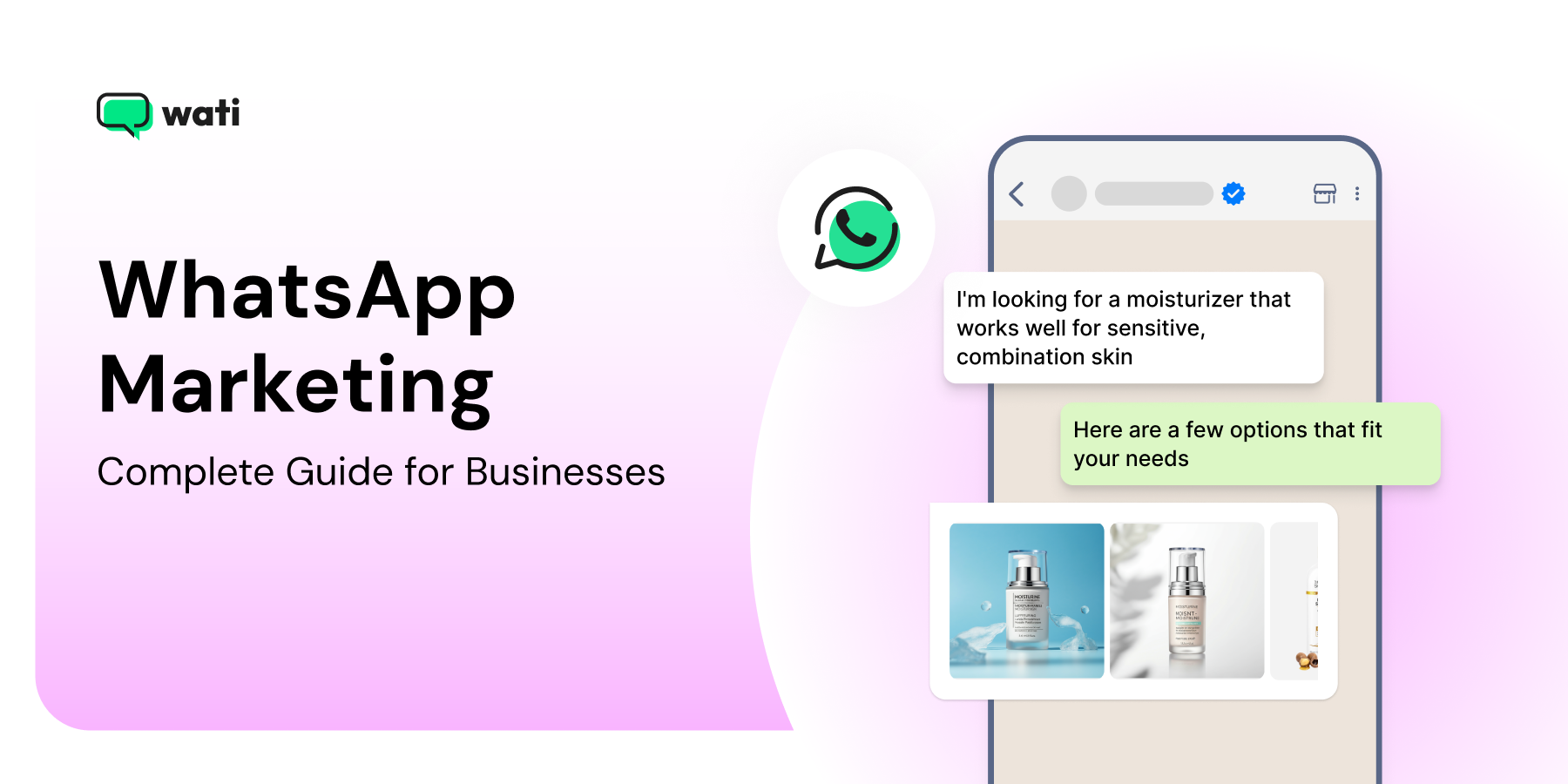
Nowadays, customers like you and me switch instantly to WhatsApp to check if their favorite product, like a pair of jeans or a new dip that you want, is back in stock.
This goes to show that we rely on WhatsApp marketing now more than ever.
With WhatsApp marketing, brands can send instant notifications, delivery updates, multimedia content, and customer resolutions, all in one platform.
By switching to a consolidated WhatsApp marketing platform, you can attribute agents for leads flowing in from multiple channels, optimize inbound engagement, and track direct ROI to improve your bottom line.
Whether you are a small, mid or an enterprise-sized business, WhatsApp marketing increases the success rates of your traditional marketing campaigns and ensures contextual engagement to increase conversions.
Let’s learn more about how WhatsApp marketing plays a pivotal role in increasing marketing-qualified leads across channels and improving your bottom line.
What is WhatsApp Marketing?
WhatsApp marketing makes it easy to connect with customers in a personal, one-to-one way. It is an interactive and conversational way to assist and nurture prospects after they put their sales inquiry.
Brands can share updates, promote products, and keep the conversation going without feeling intrusive.
Unlike traditional “batch and blast” email marketing, it offers a greater degree of message personalization with automatic responses and resources to encourage customers to complete an action.
As per a study by Grand View Research, the global messaging application API market size was estimated at USD 46.75 billion in 2024 and is projected to grow at a CAGR of 18.9% from 2025 to 2030.
This alone tells us that brands prefer to promote products and services via a streamlined WhatsApp API to maintain prospects’ interest and take prompt action for better sales.
WhatsApp API offers a suite of features to run intelligent marketing conversations and strategize sales.
The goal isn’t just to talk to your customers; it’s to build a two-way dialogue that nurtures them from awareness to purchase and loyalty.
How To Use WhatsApp For Your Business?
There are two main ways to use WhatsApp for your business: the WhatsApp Business app and the WhatsApp Business API.
The right choice depends on your goals, audience size, and the level of personalization you want in your communication.
The WhatsApp Business app is free and can be downloaded from the App Store or Google Play. Ideal for small businesses or solopreneurs, it enables you to instantly follow up with leads, send automated reminders, and redirect users to your website.
The WhatsApp Business API, on the other hand, is available through Meta-authorized API service providers.
The right choice depends on your goals, audience size, and level of personalization you want in your communication strategy.
How to do WhatsApp Marketing with WhatsApp Business API?
Using the official WhatsApp Business Platform (API) does more than just certify your brand’s authenticity. It allows you to drive immediate, personalized responses and entice quick cart action.
Running personalized broadcasts based on CRM data increases engagement, drives faster sales, and delivers a clear ROI. Here is how you can build a scalable WhatsApp marketing workflow.
1. Build a Verified Business Profile
Create a verified business profile with WhatsApp Business to set up a digital shop.
Fill out every detail, like business description, business address, active hours, official website, and logo, to establish immediate trust and authenticity with customers.
2. Secure Explicit Customer Opt-Ins
Before sharing content, ensure you set up “opt-in” to get users’ consent in advance. Use website pop-ups, checkout boxes, or QR codes to build this compliant contact list.
3. Segment Your Audience
Don’t send the same message to everyone. Use custom segments or tags (e.g., “new_leads,” “pending_orders,” “winbacks”) based on purchase history, past conversations, or interests to send highly relevant and personalized content.
4. Set Up Your Product Catalogue
This feature turns WhatsApp into a mobile shop. You can showcase all your products and services directly within the chat, making it easy for customers to browse, ask questions, and buy without ever leaving the conversation.
Also, learn how to set up your WhatsApp catalog in detail to create a frictionless shopping experience.
5. Incorporate Conversational Marketing With Whatsapp
This is where you scale. Use no-code WhatsApp chatbot tools to build chatbots that handle FAQs, qualify new leads 24/7, and route complex queries to a live agent.This provides instant service and frees up your team.
You can also address customer grievances or doubts via a WhatsApp chatbot to put them at ease.
6. Craft Clear & Engaging Messages
People read WhatsApp messages quickly, so be direct. Keep your copy concise, add valuable offers, and use quick-reply buttons and CTAs to make it effortless for the user to respond or convert.
7. Schedule and Send Broadcasts
This is the core of WhatsApp marketing campaigns. You can schedule personalized promotional messages to your segmented lists, all without saving thousands of contacts to a single phone.
WhatsApp API platforms also allow you to import leads from CRM, and customize marketing campaigns based on certain filters or parameters.
Also read: How to create a customized WhatsApp broadcast list to send seasonal updates to customers.
What Are The Best Fit Industries For WhatsApp Marketing?
In 2026, WhatsApp isn’t just a customer support channel; it is a full-fledged marketing and e-commerce platform. Brands can integrate it with their third-party ERPs to elevate the customer journey from initial qualification to closed deal.
Any industry that is solution-oriented and prioritizes customer comfort can depend on WhatsApp marketing to grow.
Here are some industries where WhatsApp fits snugly as a marketing engine.
Industry | Best-Fit Use Case | 2026 Shift |
E-commerce & Retail | Abandoned cart recovery, personalized carousels, and in-chat payments. | Live Shopping: Brands now use WhatsApp to host “mini-drops” where users buy instantly in chat. |
BFSI (Finance/Ins.) | Lead qualification for loans, policy renewals, and instant claim filing. | Hyper-Security: Secure “WhatsApp Flows” have replaced clunky web forms for sensitive data. |
EdTech | Course reminders, student onboarding, and parent-teacher communication. | Micro-Learning: 15-minute daily lesson snippets delivered via automated drip campaigns. |
Real Estate | Virtual tour scheduling, KYC document collection, and site-visit reminders. | Voice Notes: Agents use authenticated voice messages to build trust during high-value negotiations. |
Healthcare | Appointment booking, prescription reminders, and post-consultation follow-ups. | AI power: Chatbots conduct initial symptom screening before handing off to doctors. |
Travel and Hospitality | Automated check-ins, instant e-vouchers, and real-time flight/gate alerts. | The AI Concierge: 24/7 “Digital Assistants” now handle everything from WiFi passwords to room service orders, reducing front-desk load by 50%. |
Top WhatsApp Marketing Statistics For Small Businesses for 2026
From retail to healthcare to travel, WhatsApp marketing has shown a significant increase in operational efficiency, system workflows, and customer satisfaction in businesses.
Industry-wise WhatsApp Marketing Statistics for 2026
Here is an industry-wise breakdown of WhatsApp marketing adoption to understand this better.
- Retail & D2C: Brands report a 45% increase in repeat customer rates when using WhatsApp for personalized post-purchase “how-to” guides.
- FinTech: Lead-to-customer conversion rates on WhatsApp are 12x higher than email.
- Logistics: 54% of consumers now prefer receiving delivery updates on WhatsApp over any other channel.
- Travel & Hospitality: WhatsApp automation has led to 60% reduction in front desk call volumes. Routine inquiries are handled over WhatsApp.
Top User-based WhatsApp Marketing Statistics in 2026
By personalizing customer journeys and centralizing siloed workflows, WhatsApp marketing helps brands acquire more customers and improve revenue.
Here are the top customer-related WhatsApp marketing statistics, which clearly show how modern customers adopt this platform.
- Sessions and Usage: The average global user now engages with WhatsApp 23-25 times per day, spending roughly 38 minutes daily in-app.
- Engagement Rate: Interactive WhatsApp messages (using Buttons, Carousels, or List Menus) see a 45–60% engagement rate, in comparison to 2-5% email open rates.
- Usage frequency: Over 50% of users access WhatsApp daily, and 91% use it at least once a month.
- Campaigns: 90% of Indian consumers make purchase decisions influenced by WhatsApp, which they deem as their primary digital platform.
- Customer Support: 72% of customers expect instant support via WhatsApp, which reduces support costs by up to 30%.
- Repeat Customer Rate: Businesses that operate solely through WhatsApp experience a 68% repeat customer rate.
- Read rates: Studies show that in India, WhatsApp broadcasts often result in a ~70% read rate, with multi-agent features reducing response times by 45% for enterprises.
Based on the above data, we can confirm that leveraging WhatsApp greatly improves lead acquisition and improves customer interaction and retention.
How to do WhatsApp Marketing with the WhatsApp Business API Platform?
With WhatsApp Business API platforms, you can sync WhatsApp with HubSpot CRM or ERP, create contextual AI summaries before retargeting, and maintain inbox transparency with your sales team members.
Below are the ways to do WhatsApp marketing with WhatsApp Business API tools, like:
- Create your WABA account: Set up your WhatsApp Business account and get admin access to Facebook Business Manager to integrate with BSP tools.
- Set up your WhatsApp Business API account: Set up your API integration with partners like, and install WhatsApp Business for your sales team. Set up your WhatsApp Business profile and link it to your business portfolio.
- Integrate CRM or ERP with WhatsApp: Connect your API with CRM or ERP to enable bidirectional sync and transfer the lead database directly to personalize WhatsApp broadcasts to support the customer journey.
- Collect opt-ins: Collect opt-ins directly on the website to qualify leads. Ensure explicit consumer consent before running new broadcasts or driving a new content strategy.
- Set up Business profile: Create your own digital storefront with business description, product catalog, pricing, business website, address, and other details to assure your reliability as a business to the consumer.
- Segment audience: Customize marketing campaigns based on the last customer interaction or chat history. enables you to segment customers based on their recent actions to approach them in the right way.
- Design promotional templates: Use the predefined template library to design new message templates to run exciting offers, discounts, fresh launches, and earlybird vouchers to create/ignite interest again and attempt to reconvert.
- Optimize campaign workflows: Create drip campaign workflows for segmented audiences to empower them to complete a given action. Avoid over-automation of messages or follow-ups to prevent spam listing.
- Track performance with advanced analytics: Track key metrics like open rate and conversion rate. Keep track of responses for recent campaigns on segmented audiences and make use of advanced analytics to track WhatsApp ROI.
Also Read: How To Leverage Wati For WhatsApp Marketing To Engage Customers And Optimize Revenue
What are WhatsApp Marketing Conversations Designed to Do?
According to a recent study, around 87% of consumers worldwide prefer brands that connect their interactions across voice and messaging.
With WhatsApp Marketing, you can build personalized sales journeys and engage with the audience in a way they want.
According to Meta, marketing conversations on WhatsApp are designed to:
- Build Awareness: Help new customers get to know your business.
- Drive Sales: Announce deals, share promotions, and make product recommendations.
- Re-engage: Revive dormant customers with back-in-stock alerts or abandoned cart reminders.
- Build Loyalty: Strengthen relationships with personal, valuable messages like birthday offers.
Key Methods of WhatsApp Marketing: 3 Most-Workable Ways
While designing your WhatsApp marketing strategy, you can’t just dump bulk content on your prospects. If you wish to hook your inbound leads, you need to implement proven WhatsApp marketing methods.
1. Use Broadcast Templates
Structuring the right messaging is the key to gaining audience attention. It allows you to send a single message to a large, segmented list of opted-in users.
As per a study, WhatsApp boosts an open rate of 98% and a CTR rate of 45-60%, thus working wonders to capture consumer sentiment. Using WhatsApp broadcast templates helps craft clear and engaging messages to assist consumers in pursuing next steps and guide them in their journey.
Use Cases: Flash sales, new product launches, seasonal promotions, and content newsletters.
2. Conversation Marketing and AI Chatbots
This is where you use automation to qualify leads and answer questions 24/7.
A well-built chatbot can guide a user from a “Hi” to a “Here’s my order” without any human intervention, freeing up your sales team to focus on high-value conversations.
Use Cases: Answering FAQs, qualifying leads (“What’s your budget?”), and routing chats to the right team.
3. Interactive Notifications and Multimedia
Using WhatsApp marketing tools, you can send messages with quick-reply buttons (“Yes, I want that!”), videos, product catalogs, and carousels. This makes the experience richer and dramatically increases engagement. Use Cases: Abandoned cart recovery (with buttons to “Buy Now” or “Ask a Question”), order confirmations, and back-in-stock alerts
10 Key Best Practices For WhatsApp Marketing Campaigns
The power of WhatsApp is its personal nature. If you abuse that trust, you’ll be blocked.
Follow these best practices to ensure your campaigns build relationships, not burn them.
1. Segment and Personalize
Treat your WhatsApp list like an organized call directory. Use tags to segment users based on their purchase history, interests, or location. Sending a 20% off coupon for dog food to a cat owner is a fast way to get blocked. Personalize with their name, last-ordered item, etc.
2. Provide Unconditional Value
Your WhatsApp messages must be more valuable than they are intrusive. Offer “WhatsApp-only” discounts, early access to sales, or genuinely helpful tips.
Because users open WhatsApp more often than email, you need to quickly hook them and take them to the next step.
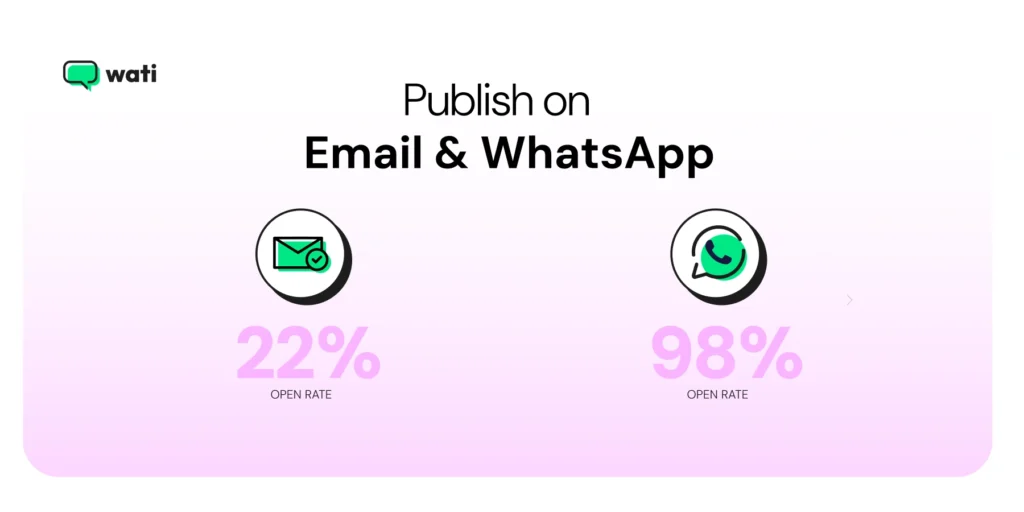
When you share a limited-time offer directly with customers on WhatsApp, they are far more likely to see it than through email or other channels.
With just one click, they can connect with your brand, explore the offer, and take action immediately.
3. Master Timing and Frequency
Customers like it when communication feels personal and effortless. WhatsApp helps businesses to respond quickly, share updates, and offer support.
Don’t message your customers at 3 AM. And don’t message them three times a day. Monitor your analytics to see when your audience is most active and limit your promotional broadcasts to 1-2 times per week at most. Utility messages (like order updates) are the exception and can be sent as needed.

4. Measure The Right Metrics
WhatsApp marketing tools give you access to data that actually helps you improve. You can track message delivery, clicks, and customer responses to see what’s working and what isn’t.
Evaluate the right success metrics like CTR (customers who tap on the links), conversion rate (clicks turning into deals), response rate (customers responding to the message), and block rate (based on customers who reported to you).
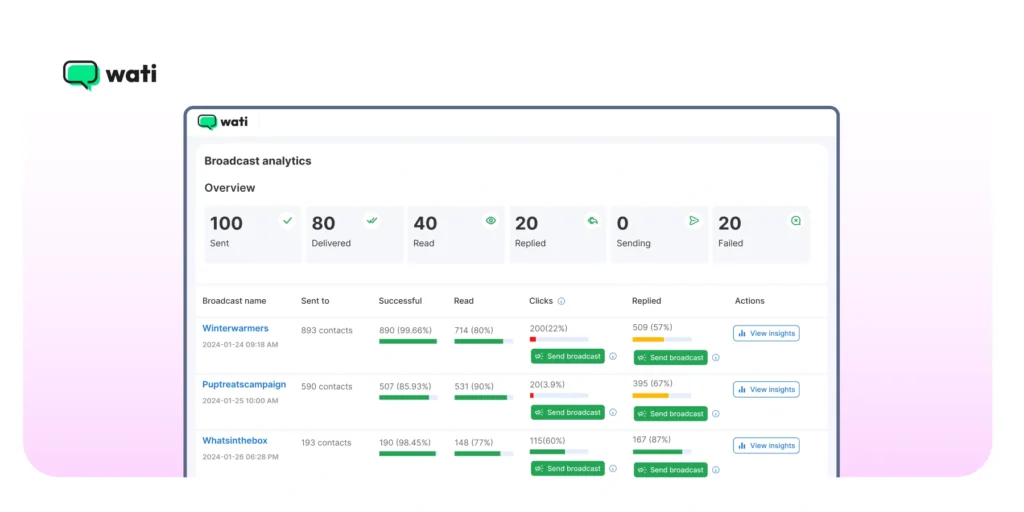
These insights make it easier to fine-tune your campaigns, better understand your audience, and create WhatsApp template messages that deliver real results.
5 Grow your audience
With WhatsApp, you can grow your audience using opt-in tools, QR codes, and click-to-WhatsApp ads to build a community.
These tools enable you to have direct interactions with prospects across multiple channels, social media apps, or offline touchpoints.
Offering an easy medium of conversation increases customer trust, which in turn can result in faster conversions and revenue.
6. Marketing Budget and ROI
With 3 billion active users, WhatsApp yields the highest return on marketing spend for businesses.
Brands can easily build WhatsApp-qualified leads across social media, email, SMS, and traffic ads and run intelligent campaigns to optimize their ROI.
By shifting a portion of search and social budget to WhatsApp, brands maximize the value out of their capital. WhatsApp campaigns have the highest delivery rate and gain customer attention faster. While brands are at it, they also deploy options like “auto reply” or “catalog call to action” to always nurture the user in the right way.
7. Conversational Newsletters
Static, one-way newsletters are being replaced by WhatsApp newsletters that allow users to browse and shop within the same chat.
As per a study, WhatsApp messages have a 98% open rate and a 45–60% click-through rate, which makes WhatsApp newsletter an effective lead nurturing tool.
Unlike email, WhatsApp newsletters drive immediate action through quick-reply buttons and carousels.
Brands can capitalize on users’ level of engagement by providing quick and instant replies/discounts or other interactive messages to lead them to a purchase.
Also read: How does consumer journey analytics improve your future WhatsApp campaigns?
8. Lower customer acquisition costs
Brands can leverage click-to-WhatsApp ads to integrate one-tap WhatsApp conversations and bridge the communication gap.
Having a direct medium for customer interaction leads to lower customer acquisition cost and higher interest levels.
Brands can send informal, friendly messages to customers within a 24-hour conversation window for free, which further optimizes marketing budget and also builds consumer sentiment.
9. Automated Lifecycle Campaigns
Messaging customers when their intent is warm is another plus point of WhatsApp. With WhatsApp automation, you can auto-schedule messages to encourage customers to shop.
From “Back in Stock” alerts to personalized abandoned reminders, these flows ensure your brand stays top-of-mind throughout the entire 180-day customer retention window.
10. Data Security and Encryption
Messages in WhatsApp are protected by WhatsApp’s end-to-end encryption, which ensures customer data remains protected, and there is no possibility of a breach.
Using an official BSP ensures that your data handling is fully compliant with global regulations like GDPR.
Read more about WhatsApp API compliance to get deeper into WhatsApp security.
How to Do WhatsApp Marketing: From Free App to Full Funnel API
This is the most critical concept for marketers to understand.
There are two versions of WhatsApp for business, and they are not the same.
Platform | How does it work? | Pros | Cons |
WhatsApp Business | This is a free app designed for single-person businesses and very small shops. | You get a business profile, quick replies, and a product catalog | You cannot build automation (no chatbots). You cannot send broadcasts to more than 256 people. You get no analytics. It is impossible to scale. |
WhatsApp Business API | The API is a “pipe” that connects to Meta’s WhatsApp servers and powers WhatsApp marketing campaigns at scale. | It offers scalability, no-code chatbot, automation, real-time analytics, team access, and CRM integrations. | It’s not a standalone app. You must use a WhatsApp marketing tool like Wati to access and manage the API. |
How to Create WhatsApp Marketing Flows in 2026?
To build a successful WhatsApp campaign, you need to guide your customers across every stage of the purchase funnel, i.e, awareness, interest, decision making, and action.
With the WhatsApp API platform, you can supervise your WhatsApp conversations at scale while targeting the right message at the right time to the right consumer.
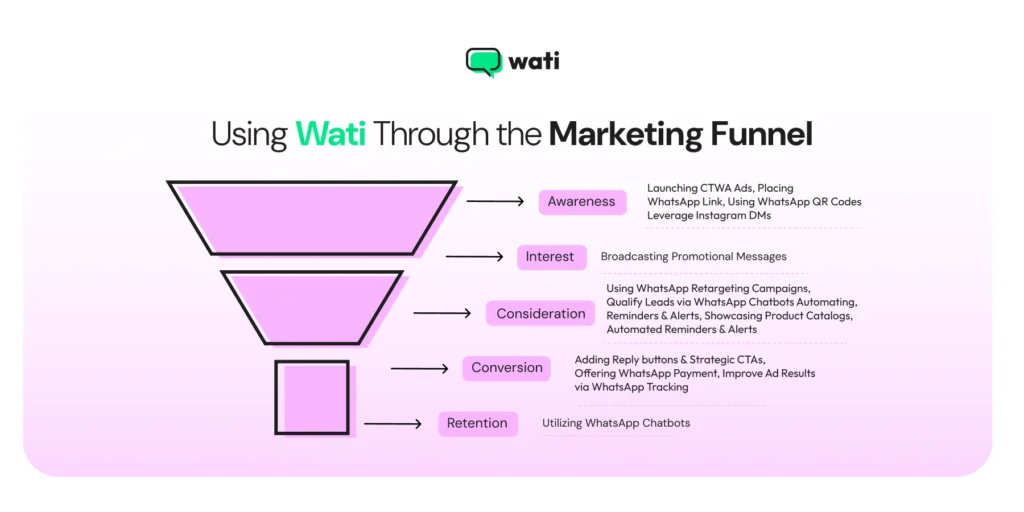
By mapping this journey, you can identify key moments where WhatsApp can help you engage, nurture, and convert your audience more effectively.
Now, let’s look at how Wati supports you at each stage of this process.
1. Awareness: Capturing Attention
To have a conversation with potential customers, you have to invest in a simple website UI that makes them comfortable and willing to click on the WhatsApp button.
For example, say you ran a click-to-WhatsApp ad on Instagram. A user clicks the ad and sends a pre-filled message (Hi, I want the 20% discount!). This lead will get registered in the team’s inbox.
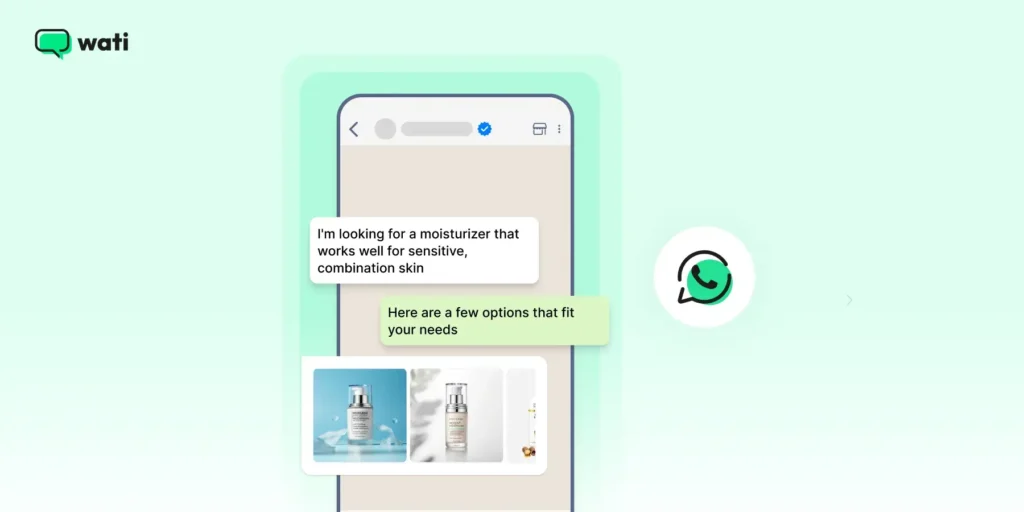
A no-code chatbot will automatically reply, “Welcome, please click on the link below or call us to get further information.”
You’ve just acquired a sales-qualified lead in seconds.
I. WhatsApp automation to engage leads
For the awareness stage, you can set personalized WhatsApp automation for leads flowing directly from the website, social media platforms, or other distribution channels.
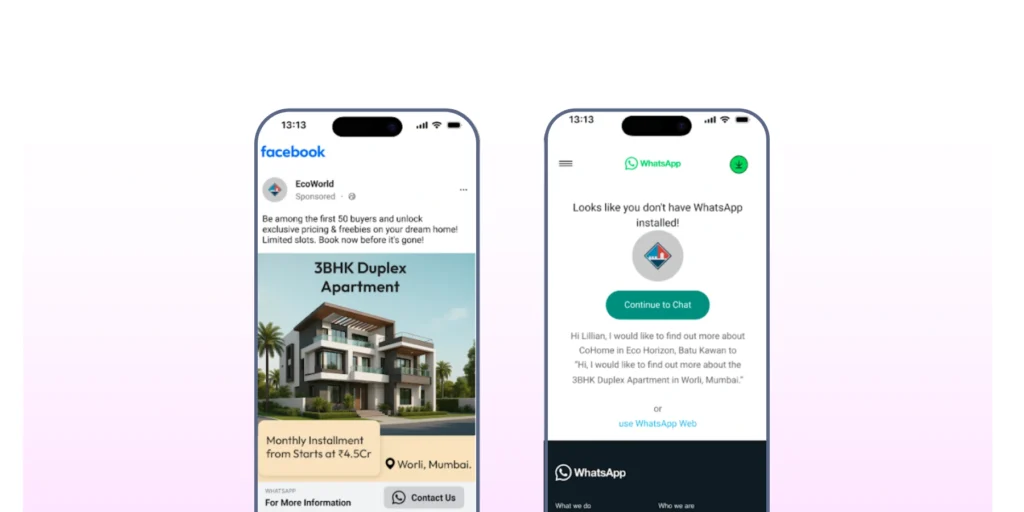
These leads can be captured, segmented, and readied for personalized communication.
When someone taps on your ad, they’re taken straight to a WhatsApp chat with your business.
II. Spread the Word With WhatsApp Links on All Platforms
Another way to attract customer conversations to your business is by using a WhatsApp link.
It’s a short URL that opens a direct chat with your WhatsApp Business account when someone clicks on it. You can create one easily with Wati’s free WhatsApp Link Generator.
You can add the link to your social media profiles, posts, emails, or even your website. Sharing it across different platforms makes it easy for anyone to start a conversation with your brand.
III. Drive Engagement With WhatsApp Qr Codes
Wati lets you create a unique QR code that connects directly to your WhatsApp Business account. When customers scan it with their phone camera, they’re instantly taken to a chat with your business.
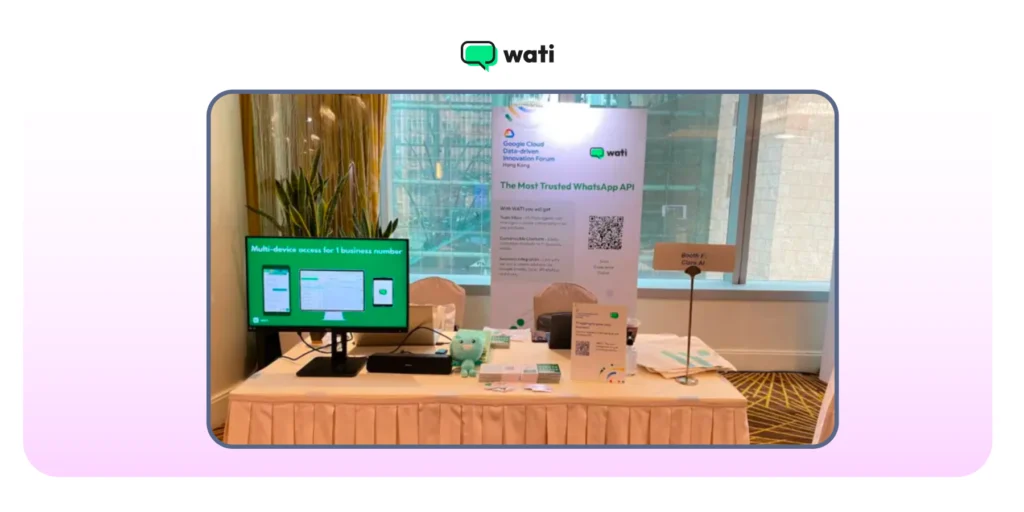
Where to Use WhatsApp QR Codes?
Below are the areas where you can use WhatsApp QR codes to display a quick engagement channel.
- Product packaging & receipts: Encourage post-purchase inquiries or support requests.
- Storefronts & events: Let walk-in customers reach you with a quick scan.
- Social media & print ads: Turn offline audiences into WhatsApp leads instantly.
IV. Convert Instagram DMs Into WhatsApp Leads
With Wati’s Instagram DM & Facebook Messenger automation, you can turn Instagram conversations into WhatsApp leads without any manual effort.
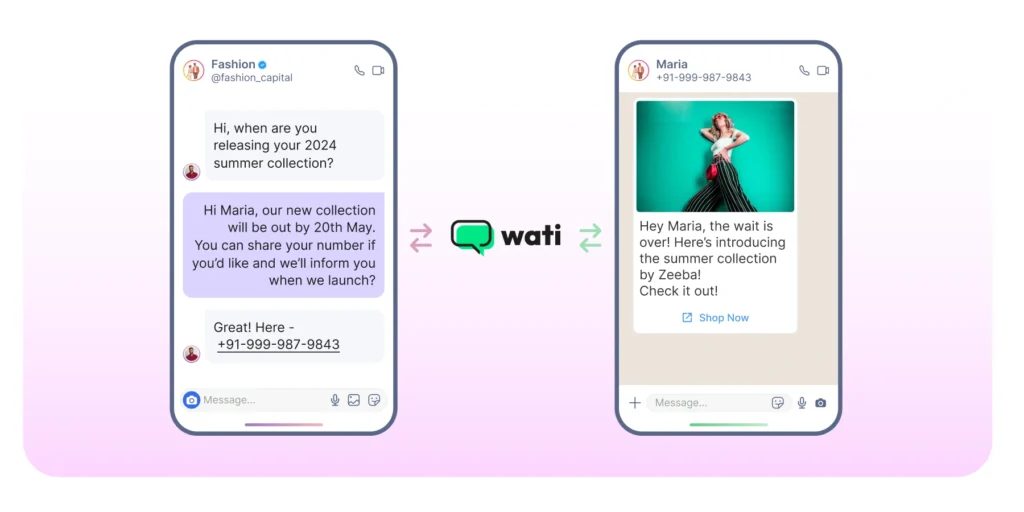
When someone messages your business on Instagram, Wati automatically captures their contact details and adds them to your WhatsApp list.
This lets you move the chat to WhatsApp, where engagement is higher, and conversations feel more personal.
2. Interest: Engaging Potential Customers
For example, if the lead asks a question, “When are you releasing the spring collection?”, Wati can chime in to auto-respond with a no-code chatbot builder.
The chatbot can handle simple FAQs. If the question is complex, it automatically routes the chat to a live sales agent. The agent sees the entire chat history in the Team Inbox and can send a picture of the spring collection from your product catalog, all within WhatsApp.
3. Consideration: Nurturing Leads
Not every potential customer will buy right away. During this stage, your goal is to keep the conversation going and build trust.
Share helpful updates, answer questions, and remind leads about products they’ve shown interest in. Automated messages and follow-ups can help you stay consistent without being intrusive.
If the customer is ready to buy, enables them to progress with adding items to their shopping cart with integrations of Shopify.
It automates the entire e-commerce lifecycle from order processing to payment transfer, all via one WhatsApp Business account.
You can also segment your audience to send personalized offers or product recommendations that cater to their specific needs.
I. Qualify Leads Using WhatsApp Chatbots
After you’ve reconnected with a lead, the next step is to understand how close they are to making a purchase.
WhatsApp chatbots make this easy by guiding users through conversations that ask the right questions and automatically collect key details.
For example, a chatbot can ask about their preferred product, budget range, or whether they’re buying for personal or business use. Based on their answers, you can group leads, send tailored follow-ups, or pass them directly to the sales team.
II. Showcase Your Offerings With WhatsApp Product Catalogs
A WhatsApp Product Catalog makes shopping easier for your customers by letting them explore your products or services directly in chat. There is no need to send them to a website because everything they need is right there.
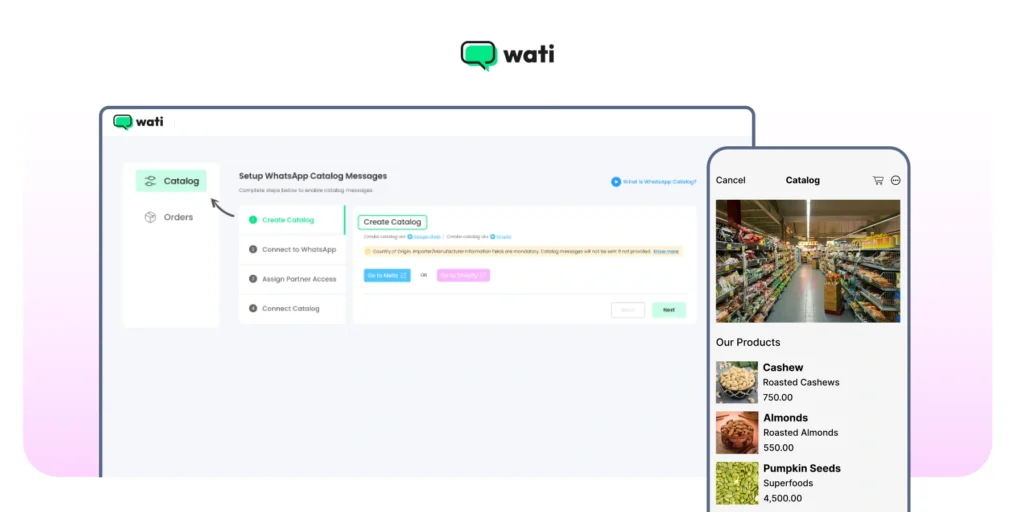
Why use WhatsApp Product Catalogs?
Using product catalogues on WhatsApp prevents consumers from unnecessary scrolling. Here is how it helps:
- Better browsing experience: Customers can see product images, details, and prices without leaving WhatsApp.
- Faster decisions: All the information is in one place, so they can make quicker.
- Direct communication: Customers can ask questions and buy instantly within the chat.
4. Conversion: Turning Interest into Sales
To turn a one-time shopper into a repeat customer, you need to ideate a customer retention workflow that keeps the shopper on the brand radar.
Features such as chat buttons and quick replies help customers move through the buying process faster and with less effort. In regions where it is supported, in-chat payments make checkout even more convenient by allowing users to pay directly within WhatsApp.
I. Make Messaging a Breeze With Quick Reply Buttons and Calls to Action
With the below-mentioned features, you can establish a quick turnaround with customers and build communication bridges easily.
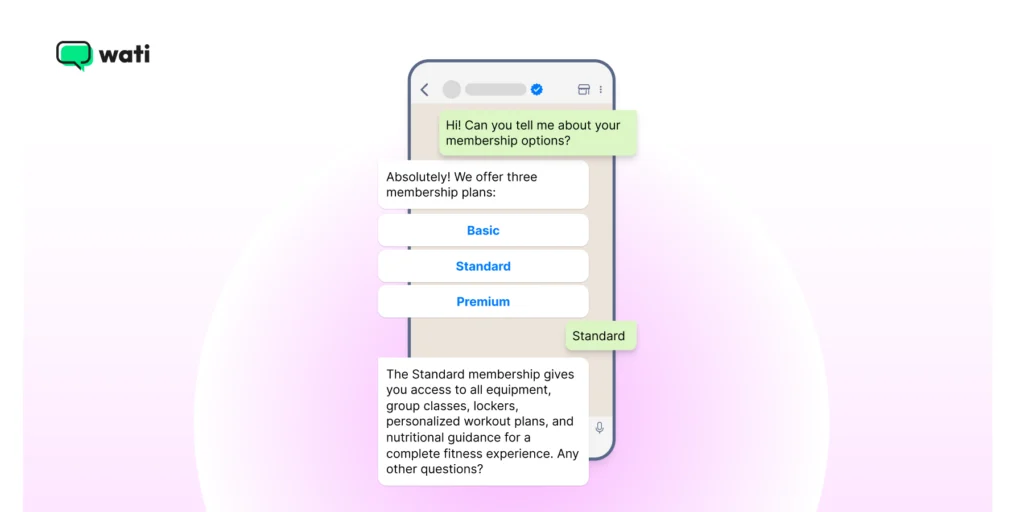
- Call-to-Action (CTA) Buttons: Buttons like “Buy Now” or “Register Here” make it easy to guide users toward key actions and boost conversions.
- Quick Replies: Automated replies help consumers. Like, if someone asks about gym membership, your chatbot can display buttons labeled “Basic” and “Standard.” The user simply taps their choice to continue the chat.
II. Make Buying Effortless With WhatsApp Payments
When a customer decides to make a purchase, they can complete the entire transaction right within the chat, without needing to switch apps or open a website.
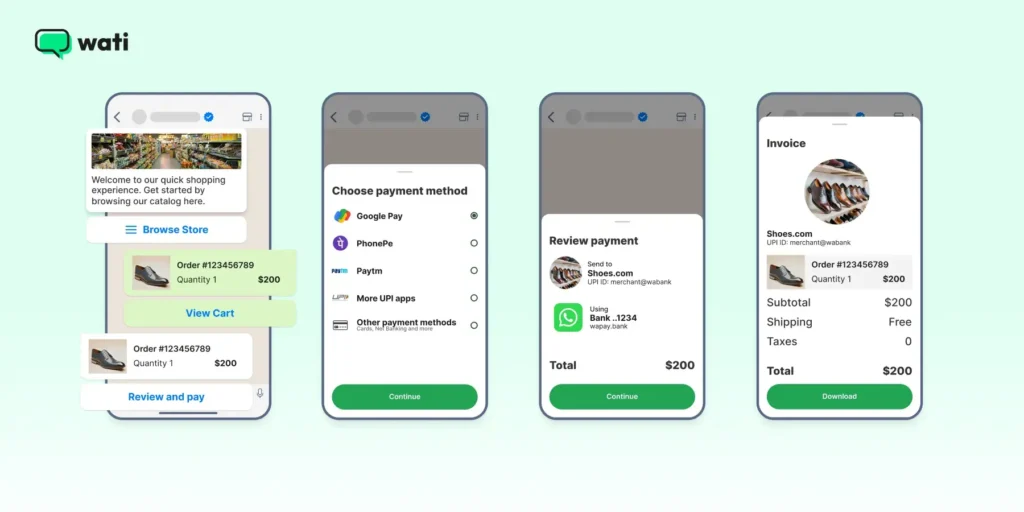
By integrating WhatsApp Pay, you offer customers a quick and secure way to pay. It shortens the shopping experience, making it smooth and convenient.
III. Boost Ad Performance With Conversion Tracking on WhatsApp
You’re not just closing sales; you’re also learning from them. By linking your WhatsApp Business account with Meta Business Manager, you can send conversion data back to Meta and understand what’s driving results.
Meta identifies which ads lead to real actions, such as purchases or sign-ups through WhatsApp, and adjusts targeting accordingly.
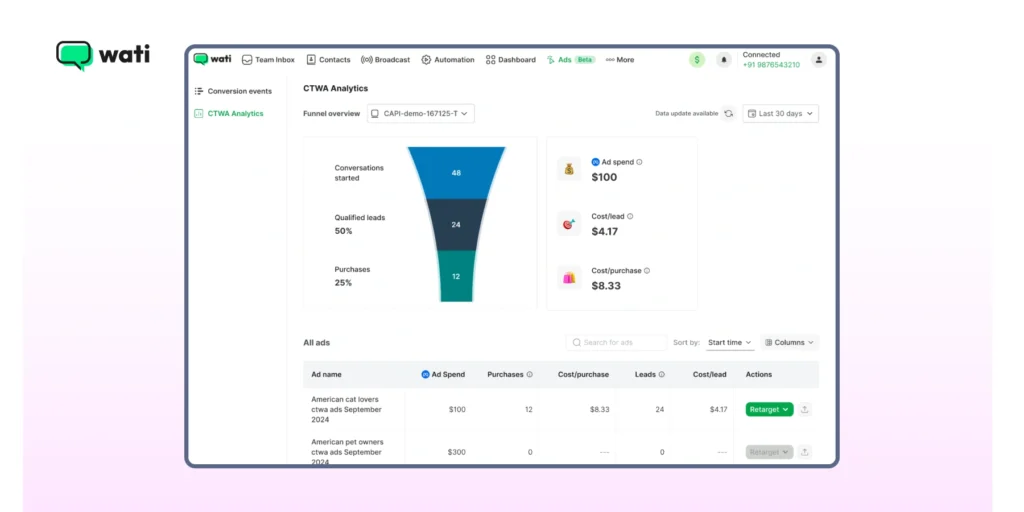
Better targeting leads to improved performance and reduced waste on ad spends. Every tracked conversation and conversion helps your future campaigns perform even better.
This integration keeps your funnel connected from click to chat to conversion, helping you measure and improve results more effectively.
All of this is tracked in Wati’s analytics dashboard, so you can show your manager the exact WhatsApp Marketing ROI of every campaign, from ad click to final sale.
5. Retention: Keeping Customers Engaged
A WhatsApp chatbot helps your business stay available to customers around the clock. It can answer questions, share information, and provide support, even when your team is offline.
The chatbot can also make personalized recommendations, guide customers to the right products, complete the purchase journey, or send real-time shipping updates to customers who placed the order.
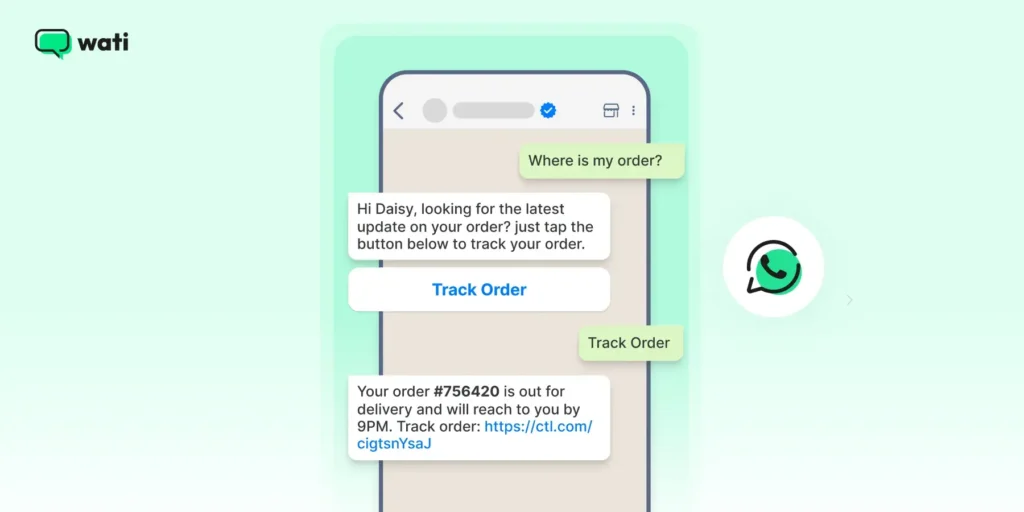
With Wati’s no-code chatbot builder, you can set up a WhatsApp chatbot quickly and start creating smooth, always-on conversations that keep customers coming back.
6. Tracking Performance and Measuring ROI
Once your WhatsApp campaigns are running, it’s important to track how they’re performing. Analytics help you understand what’s working, what needs improvement, and how customers are responding.
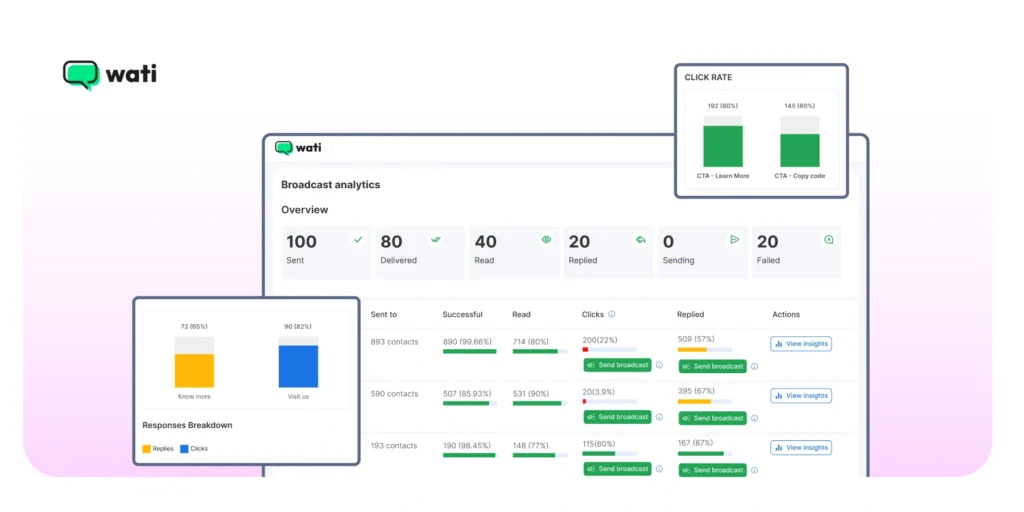
You can monitor key metrics like message delivery, click-through rates, replies, and ad-to-chat conversions. This data helps you fine-tune your approach and improve results over time.
Top 3 WhatsApp Marketing Examples To Consider in 2026
Now, let’s look at some brands that are doing WhatsApp marketing really well.
1. Blacklyf’s D2C WhatsApp Marketing Campaign
Blacklyf, Uganda’s first direct-to-consumer audio and wearable electronics brand, turned to WhatsApp as its main channel for customer engagement and support.
With its commitment to winning customer trust through warranty policies and responsive service, Blacklyf has made WhatsApp its primary channel for customer acquisition and support, aligning with local preferences for communication and trust-building.
Using Wati’s Click-to-WhatsApp solution, the brand transitioned from a website-first approach to direct, real-time conversations.
What Were the Results of Blacklyf’s WhatsApp Marketing Campaign?
With Wati, Blacklyf observed the following improvements in their sales numbers:
- 3x higher conversion rate
- 21% increase in lead volume
- 60% lower acquisition cost
Refer to our case study to understand how Blacklyf boosted its conversion rate, lead volume, and clickthrough rate while reducing acquisition costs.
2. Habuild’s Wellness-Based WhatsApp Marketing Campaign
Habuild is an online wellness platform focused on yoga and habit building. Since many of its users prefer WhatsApp over other apps, the platform made WhatsApp its main channel to stay connected with customers around the clock.
With Wati, Habuild used chatbots and automated communication flows to engage users and build a stronger sense of community. Users could browse through yoga workout routines and other wellness-related details to build a stronger and healthier lifestyle.
What Were the Results of Habuild’s WhatsApp Marketing Campaign?
With Wati’s integrated chatbot support, Habuild got instant results mentioned as follows:
- Grew from 400 to 3.8 lakh users in just 4 years.
- Scaled to over 3.1 lakh customers with Wati’s chatbots and automations.
- 246,352 live viewers on YouTube, with over 5 million messages sent on events like “International Yoga Day”.
Check out our case study on how Habuild deployed Wati to launch their WhatsApp Marketing Campaign and increased their customer base.
3. Zostel’s Travel-First Automation and Engagement Campaign
Zostel redefined front-desk operations and mobile support with WhatsApp to assist travellers better. It integrated WhatsApp as its primary communication engine to manage the guest lifecycle across its extensive network of hostels and homes.
By partnering with Zostel transitioned from manual, fragmented guest interactions to a structured, automated workflow.
Using chatbots and specialized campaign triggers, they provided instant support for booking changes, directions, and on-ground activities, ensuring a seamless experience for the modern global traveler.
What Were the Results of Zostel’s WhatsApp Marketing Campaign?
By leveraging automation and a shared team inbox, Zostel achieved the following measurable outcomes:
- 40% reduction in first response times through structured routing and automated workflows for guest inquiries.
- 45% decrease in manual work per booking, significantly reducing the administrative load on property managers.
- 10–15% uplift in bookings driven by targeted WhatsApp promotional campaigns for specific properties and trips.
- Increase in CSAT score from 4.2 to 4.5, reflecting improved guest satisfaction with real-time, automated communication.
Check out our case study to learn how Zostel integrated to optimize travel bookings and operations.
Harness The Power Of WhatsApp ROI Now!
Now is a fantastic time to capitalize on modern WhatsApp marketing, without relying on bulk spray and pray.
Having access to the WhatsApp API helps you tailor the customer journey in ways unimaginable and assure customers that you’ve got them.
WhatsApp Marketing is no longer an experiment; it is a pillar of any successful digital strategy. By moving the “pushy” sales status quo to a “personalized and conversational” type, you establish yourself as a cult in a market full of noise.
Switch to WhatsApp marketing now and make that switch to build genuine trust and unlock your door to the fastest customer engagement, loyalty, and retention. Ready to make the move? Book a demo to see how WATI turns WhatsApp into your growth engine.
Frequently asked questions
Is WhatsApp marketing legal?
Yes, 100%, as long as you are compliant. The golden rule is that you must get explicit user consent (opt-in) before sending them any promotional messages.
What is the difference between the WhatsApp Business App and the API?
The Business App is free, for one user on one phone, and has no automation or broadcast scaling. It's for micro-businesses. The Business API is the tool for marketers, allowing for chatbots, team inboxes, mass broadcasts, and integrations. You need a platform like Wati to use the API.
How much does WhatsApp marketing cost?
The cost has two parts. The Platform Fee is the monthly subscription fee of your WhatsApp marketing software (like Wati). The conversation fee is what Meta (WhatsApp’s parent company) charges per conversation (a 24-hour window). Marketing-initiated conversations cost less, but ROI is high due to high conversions.
Can I connect WhatsApp marketing to my CRM or ERP?
Yes, and you absolutely should. The main power of the WhatsApp Business API is its ability to integrate with your existing marketing stack. Platforms like Wati offer native or Zapier integrations for HubSpot, Zoho, Shopify, WooCommerce, and hundreds of other tools, allowing you to sync customer data and automate workflows.
Related posts
- WhatsApp Marketing Messages Examples: WhatsApp Promotional Messages
WhatsApp marketing messages for businesses: Boost engagement and sales with our examples of WhatsApp promotional messages.
- WhatsApp Marketing vs SMS Marketing: A Comparison
Discover WhatsApp Marketing’s potential: boost customer engagement, enhance support & drive sales with rich media 🚀. Transform your marketing strategy!
- WhatsApp Features 2026: Latest Updates, Best Practices and More
Learn about the latest WhatsApp new features for businesses that simplify chats, boost engagement, and help you connect with customers effortlessly in 2026.
- Making the WhatsApp API for Edtech Work for Your Team in 2026
Learn how WhatsApp API for EdTech helps automate class reminders, share notes, send progress reports, and improve student communication.